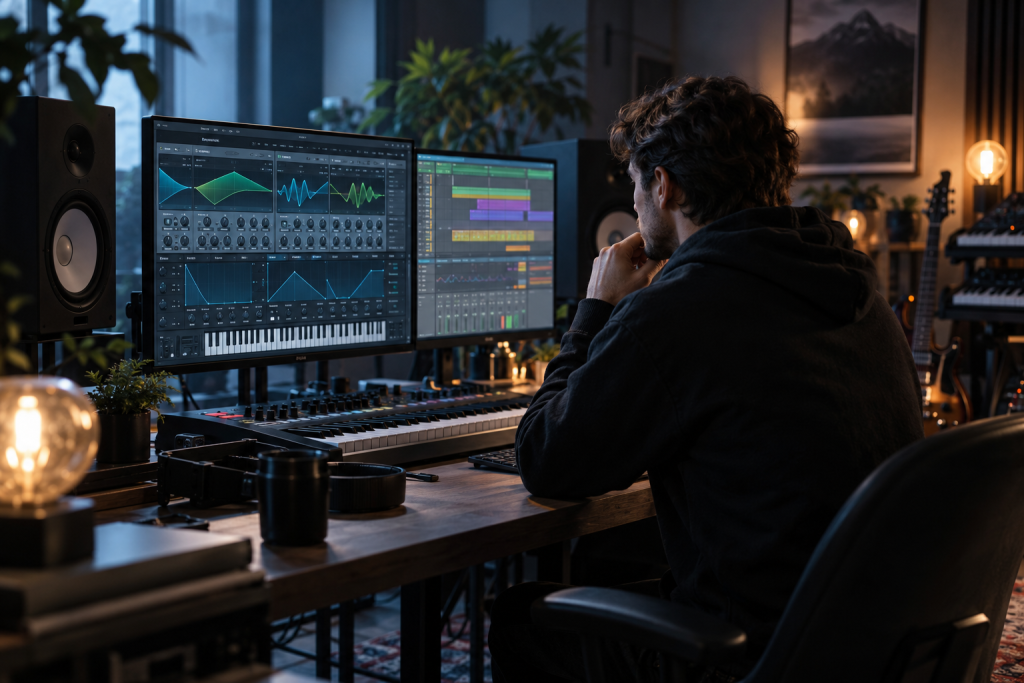
Serum 2 is out. If you have spent the last decade dragging LFOs onto cutoff knobs in the original, your first question is not “is it good.” It is “do I pay again for something I already own.” That depends entirely on how you use Serum, and the answer splits cleanly depending on whether you are a preset-surfer or someone who builds patches from an init state at 2am.
Let me be honest about the limits of what I can verify here. Xfer has not handed me a changelog I can quote line by line, so I am not going to invent feature names, version numbers, or a list of new filters and pretend I tested them. What I can do is lay out what Serum actually was, what its real weaknesses were, and who has a genuine reason to move versus who can sit tight on the original for another two years.
What the original Serum actually was
Worth resetting the baseline, because a lot of people bought Serum for the wrong reasons and never touched half of it.
The engine runs on four sources: two wavetable oscillators, a flexible noise generator, and a sub-oscillator. That is it. No FM operator page, no additive drawing tools, no granular mode. The pitch is that the wavetable engine is deep but the architecture is deliberately narrow, and the sound design happens through routing and modulation rather than through a pile of synthesis methods.
The part that made Serum stick for me was never the oscillators. It was the modulation system. Drag and drop onto any parameter, four macro controls, three envelopes, four LFOs, a proper mod matrix underneath for the fiddly stuff. Anyone who has fought a synth where modulation is buried three menus deep knows how much that layout matters. Serum made complex movement feel casual.
Then there is the filter and FX section, and this is where I think the plugin quietly outclasses synths that cost more. You get over 75 filter types, covering the standard low, high and band pass territory plus a long tail of character filters. Ten separate effect rack units sit on top. A lot of my finished sounds never leave Serum because the onboard distortion, chorus and reverb are good enough to skip a third-party chain.
Presets: 400-plus patches and roughly 150 wavetables in the box. Price sits at $189, with rent-to-own through Splice at 0% interest, and payments can be frozen if a month gets tight. Formats cover VST, VST3, AU, AAX and LV2, 64-bit, on Win10 and Win11 plus Apple Silicon and macOS 10.12 and up.
Where Serum 1 was genuinely weak
Two real complaints, and I will not pretend they did not matter.
- It does not sound analog. Serum is clean and precise. If you want warmth, you have to work for it with saturation, drift and filter choice. Diva does that job with no effort and a brutal CPU bill. Serum does not, and no update changes the fundamental character of a wavetable engine that was built to be clean.
- The architecture is stripped back. Against Omnisphere, Falcon or Phase Plant, Serum is a narrow instrument. If your music needs hybrid synthesis, sample import as an oscillator source, or huge cinematic libraries, Serum was never the right tool and a version bump will not make it one.
Neither of those is a bug. They are the tradeoff you accepted when you bought a fast, visual, workflow-first synth for $189.
Who should actually care about Serum 2
This is the part people skip. Read your own habits before you read a feature list.
Upgrade if you hit walls. If you have caught yourself thinking “I wish I could do X in Serum” and then opening a second plugin to finish the patch, you are the target buyer. Every wall you have hit in the original is the reason a new version exists. You will know your own list within about five minutes of thinking about it.
Upgrade if you build patches, not songs. Sound designers who live in the mod matrix and the FX rack get the most out of any meaningful change to a synth. More room in the engine translates directly to more hours saved per week.
Wait if you mostly browse presets. Be honest. If your Serum usage is opening a bass patch, tweaking the filter, and moving on, a new version changes very little about your day. The old presets still load. The old workflow still works.
Wait if your CPU is already tight. Before anything else, check how the new build runs on your machine. Serum has historically been light on CPU, but new engines and new effects are exactly where that reputation gets tested. Do not buy on day one of a release cycle. Let other people find the bugs.
Consider staying put if you are on Vital or Pigments. Vital gives you premium wavetable features for free. Pigments gives you a hybrid engine and a genuinely different workflow. If either already covers your needs, Serum 2 is a want, not a need, and admission of that saves you $189.
The upgrade pricing question
One thing I will not do is guess at the upgrade cost. Xfer has not published numbers I can verify to you, and inventing a figure would be worse than saying nothing. Check the Xfer Records site directly and read the upgrade terms before you assume anything. Existing owners are usually treated differently from new buyers, but confirm it.
What I can say is this: the original Serum at $189, plus Splice rent-to-own at 0% interest with the ability to freeze payments, was already one of the fairest deals in software synths. Whatever Xfer charges existing users, weigh it against how many hours you have spent in the plugin. That ratio is normally uncomfortable in a good way.
Some practical advice before you spend a weekend on it
Do not install Serum 2 the night before a deadline. Version one-point-oh of anything has edges, and a synth update can break saved projects or change how a patch loads. Back up your current install, keep the old version alongside the new one if the installer allows it, and open a few finished tracks to check nothing moved.
Then spend one session recreating a patch you already know well in the old version. That tells you more about whether the upgrade earns its keep than any review, including this one. You will feel the workflow changes immediately, or you will shrug and close the window.
Serum earned its place because it was fast, visual, and honest about what it was. If the second version keeps that and adds room where the old engine ran out, it is worth the money. If it turns into a different plugin with a Serum badge, the original is still sitting on your drive, and nobody is forcing you to move.