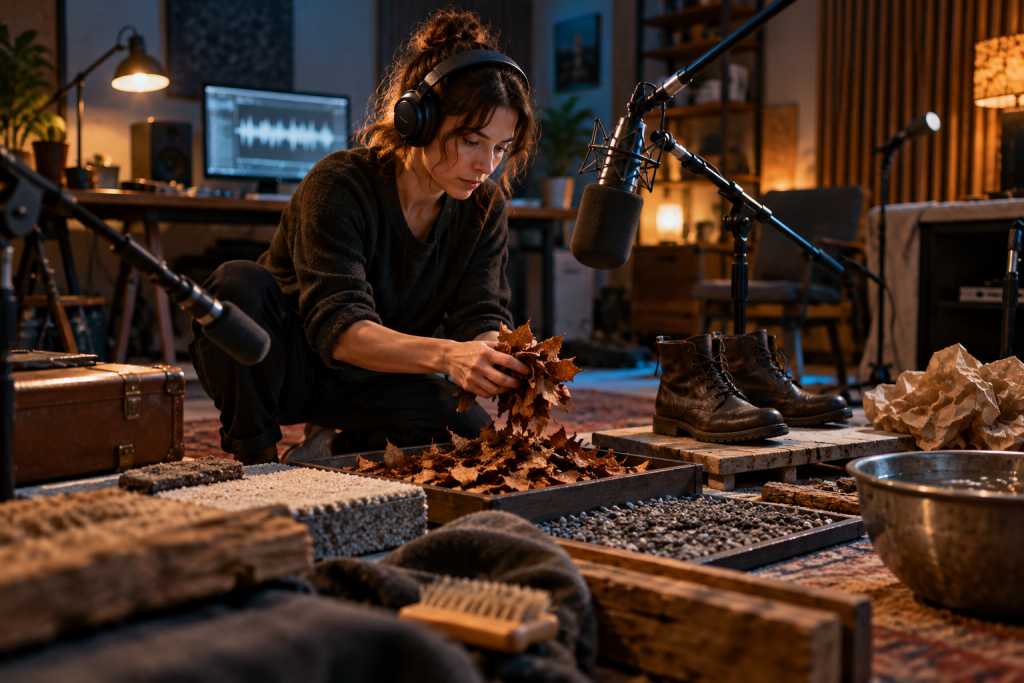
Recording your own foley is the cheapest upgrade your sound design has. No subscription, no license headache, no disappointed folder of “close enough” library hits. You need a mic, a quiet-ish room, and the willingness to sit on the floor hitting a cabbage with a screwdriver for twenty minutes.
That last part matters more than the gear. Nick Peck, a sound designer and synthesist who’s spent a career in picture sound, built an entire horror ambience by recording six or seven friends whispering in a circle during an Oscars party, then pushing those takes through reverse reverb and delays. No premium library. Just a room full of people and a processing chain.
That’s the whole thesis of home foley: constraint forces you to grab what’s actually around you, and what’s around you tends to sound more distinctive than the same Kontakt library everyone else owns.
Why your own foley beats another library download
Libraries are convenient and often excellent. But they have a sameness problem. If fifty producers license the same footsteps pack, everyone’s trailer hits the same. Your kitchen doesn’t have that problem.
A few practical wins from recording your own:
- Nobody else has your takes. The specific clang of your radiator is a signature, not a preset.
- You can match the picture exactly. Need a door creak that syncs to a 2.4-second shot? Record ten creaks, cut the best one, done.
- You learn how sound actually behaves. Hitting a mic with real physics teaches you more about transient design than any tutorial.
- You own the rights outright. No attribution, no “for sync use only” clauses buried in a readme.
The tradeoff is time. A library gives you fifty variants in a zip file. Home foley gives you three good ones after an hour. If you’re on a deadline, that math doesn’t always work. Be honest with yourself about it.
Gear: what you actually need
You don’t need a Neumann. You need a mic that isn’t noisy and a room that isn’t a bathroom.
A condenser is the default pick for detail, but a dynamic will survive being hit by a wrench, which is a real consideration when your “instrument” is a garbage bag full of rocks. A portable recorder is genuinely great here, not because the preamps are better but because you can take it to the source instead of bringing the source to the mic.
The recording setup advice from vocal sessions applies almost directly. Pop filter about 30cm from the capsule, input gain peaking around -6dB, no clipping. Gain staging matters even more for foley than vocals, because a cabinet slam has a much wider dynamic range than a sung phrase. Set your peaks conservatively and you’ll thank yourself in post.
One thing people skip: record the same source from multiple distances. A footstep at 10cm, 50cm, and 2m gives you three very different sonic characters from one performance. That’s free variety.
Room treatment, the boring part
Reflections, background noise, and room resonance will mess up your takes more than a mediocre mic will. A treated or dead room beats a great mic in a lively one. If you don’t have treatment, record in a closet, under a blanket fort, or at 3am when the fridge compressor finally shuts up.
Record ten seconds of silence first. That’s your noise floor. Listen to it on headphones. If you can hear your computer fan, it’ll be baked into every foley take you make.
Sources: start with the kitchen and the junk drawer
Foley artists work from a prop table for a reason. Anything can be a sound. The skill is matching texture and weight.
- Footsteps: shoes on different surfaces (wood, gravel, carpet, wet tile). Break the walk into heel and toe hits if you want more control.
- Cloth and movement: jacket sleeves, a scarf, denim rubbing against a couch. These are the layers that make a character feel present.
- Impacts and punches: a cabbage or melon for body hits, a leather bag for weight, celery snapping for bone.
- Metal and mechanism: keys, coins, zippers, a bike chain, a cheap door hinge.
- Fire and weather: crinkled cellophane sounds like fire. A hair dryer pointed at a mic at low gain is controllable wind.
The trick is not the object. It’s how you hit it. Same cabbage, different mallets, different results.
Processing: where foley becomes design
Raw foley is raw material. The transformation happens after.
Delay is the workhorse. Delay records an input signal and plays it back after a set period, mixing it with the live audio so the original is heard followed by the echo, and feedback lets you build a decaying repeat. That’s the foundation of reverse-reverb ghost ambiences and the reason a single whisper can become a crowd.
Convolution effects are the other big move. The Voxpat plugin, for example, pairs a sample convolver that loads up to four samples with noise generators, pitch shifters, and a sample player that can follow incoming audio volume. Running these in parallel is what thickens a growl into a monster. The catch, as the Bedroom Producers Blog review notes, is that parallel processing often stops sounding like one voice and starts sounding like a chorus. Great for creatures. Wrong for realism.
If you’re shaping pitch, note that Voxpat’s shifters move in integer semitones, so no microtonal moves. That’s fine for musical shifts and alien chirps, limiting for subtle warping.
Quick processing chain for a monster growl
- Record a low growl close to the mic, plus the same growl whispered.
- Pitch the whisper down and layer it under the growl.
- Send both through a parallel convolution chain for grit.
- Add a short delay with high feedback, then reverse it for a tail.
- EQ each layer independently to cut mud before mixing.
That last point isn’t optional. Extreme processing creates harsh and muddy frequencies fast, so each layer needs its own EQ pass. Cutting before you compress saves you from fighting it later.
Editing and file hygiene
Recording is half the job. The other half is a painful amount of trimming.
Name files so you can find them in six months. “Footstep_wood_heel_03_48k” beats “take7final2.” Keep your raw recordings. You’ll want to re-process a take later with new tools, and re-recording is always more expensive than re-processing.
Normalize conservatively, not to zero. Leave headroom for the processing that comes next. And back it up somewhere that isn’t the drive your DAW lives on.
What this won’t fix
Home foley won’t replace a good library for anything you need in bulk: crowd walla, complex machinery, orchestral hits. Those are worth licensing. It also won’t fix a bad room. If your noise floor is audible, no amount of processing buries it cleanly.
And it’s slower than you think. The first session, you’ll record forty takes and keep four. That ratio improves with practice, but it never becomes efficient. It becomes fun instead, which is a different thing.
Start with one sound. Footsteps on whatever floor you’re standing on right now. Record them badly, process them, stop. The second session will be better, and by the fifth you’ll have a personal library nobody else can download.