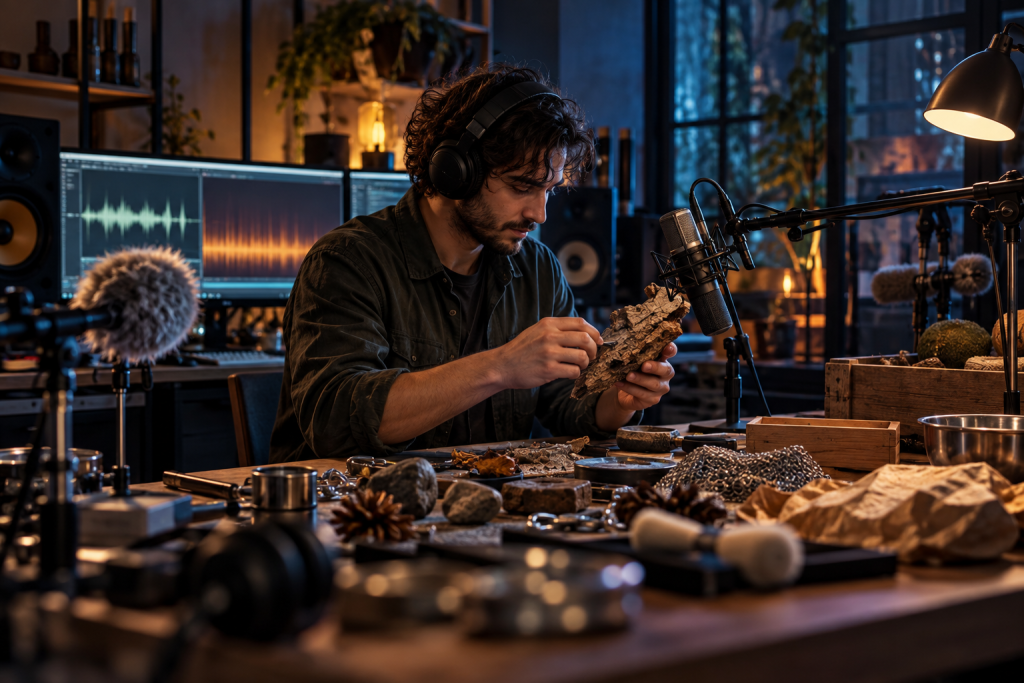
Most sound effects libraries are too big. That sounds like a weird thing to say when we’re talking about building a working library for video and games, but it’s the honest starting point. Producers and sound designers keep buying 40 GB packs to solve a 200 MB problem, then wondering why they’re still reaching for the same three whoosh samples every project. I’ve watched this cycle for years, and the fix isn’t a bigger drive. It’s a tighter plan.
Start with the jobs you actually need to fill
A sound effects library for video and games looks nothing like a music sample pack. Game audio has to loop, react, and layer in real time. Video sound has to hit picture. Those are different problems than “I need a drum break.”
So before you download anything, list the roles you keep hiring sounds for. Impact hits. Whooshes and transitions. Ambiences and room tones. UI clicks and menu feedback. Foley footsteps. Weapon or mechanic sounds if you’re scoring a game. That list is your shopping list.
Output’s breakdown of sample libraries makes a point that applies directly here: libraries split into all-in-one collections, section-specific collections, loop and phrase packs, and playable instruments. Sound effects follow a similar logic. You either buy a broad generalist library to cover everything badly, or you buy focused packs that each do one job well. For a working kit, the second option wins almost every time.
What “good” actually means for an effects library
I judge sound effects libraries on three things, and none of them are file count.
- Mix-readiness: can I drop this into a session and have it sit without carving it up with EQ and compression? If every impact needs three plugins to not sound muddy, the library is failing at the source.
- Sonic character: does it give me something I can’t easily recreate myself? A generic whoosh is worthless. A whoosh recorded through a specific piece of metal is not.
- Licensing: is it royalty-free for commercial releases, games, and client work? Read the terms before the download, not after.
Also worth checking: update cadence. A library that grows is worth more than a static one you’ll outgrow. A smaller, curated collection you actually use beats a massive folder gathering dust. That’s not a slogan, it’s just what happens on real deadlines.
Field recordings versus designed sounds
This is the fork in the road most people don’t think about clearly.
Raw source material is unprocessed audio you shape yourself: impacts, textures, ambiences caught on a recorder. Designed sounds come pre-mangled, with risers, booms, and cinematic sweeps baked in. Both have a place, but they solve different problems.
The Kedr Audio Ultimate Experimental Producer Bundle is a good example of raw source done right. It splits into packs you’d never buy individually but are glad exist in a bundle: Aquaria with hydrophone water recordings, Electromagnetic Fields at 7.4 GB of electrical hum and glitch textures, Impacto: Morphed Acoustics for cinematic booms and risers, and Kinetics: Construction Kit at 4.54 GB of raw grinding, scraping, and metal-on-metal source recordings. That last one is the interesting bit. A construction kit is raw clay. You get far more mileage from it than from a folder of finished trailer hits, because you decide what it becomes.
The counterargument: raw source takes time. If you’re cutting a game trailer this week, a designed pack gets you there faster. Buy both types, but be honest about which one you’re actually going to use.
Free libraries are better than they’ve ever been
I’ll say this plainly because a lot of paid packs don’t want to hear it: some of the best material is currently free.
Krampfstadt Studio’s WIND GUSTS library, distributed through A Sound Effect, is a 37-file, 37-minute storm recording collection that normally sells for $35 and has been given away on a limited basis. That’s a single-purpose, no-filler pack. If you need wind, you now own it. If you don’t, you scroll past it. That’s the correct model.
Free doesn’t mean bad anymore. It means someone is building an audience, or the library is a loss leader, or the creator just wants the material out there. Take the win, check the license, move on.
The Nick Peck lesson: constraint beats gear
Here’s the most useful thing I’ve heard on this subject in a while. Nick Peck, who’s worked on hundreds of Star Wars projects since 1998 and served as Audio Director on Star Wars Battlefront, abandoned high-end field recorders in favor of a Zoom H4N. No loss in results, by his own account.
He also talks about respecting an established sonic vocabulary as a discipline rather than a constraint. If a project already has a sound identity, your job is to extend it, not reinvent it.
The other story that stuck with me: for a horror project, he recorded six or seven friends whispering in a circle at an Academy Awards gathering, then ran those recordings through reverse reverb and delay to build ghost ambiences from scratch. No library purchase. No premium chain. A living room full of people and a couple of processing moves.
That’s the whole argument for recording your own source material in one anecdote. A recorder you already own and a phone in a stairwell will get you sounds nobody else has, because nobody else was in that stairwell.
And if you’re new to this: sound design, as a discipline, is exactly this. Specifying, acquiring, and creating audio with whatever tools and techniques the medium needs. Synthesizers count. Foley counts. A field recorder counts. It’s all the same job.
Processing is where a library stops being a library
Even great source material needs shaping, especially for game and video work where one sound has to serve many contexts. I keep a small toolkit for this.
Pitch shifting is the obvious first move. Drop a metal scrape two octaves and it becomes a creature. Push a whoosh up and it becomes a UI transition. Time stretching turns a short impact into a sustained drone. Reverse reverb and delay build the ghost-ambience trick Peck described, and they work on any source, not just voices.
If you want a dedicated mangler, tools like Digital Brain’s Voxpat show how far one plugin can stretch a source. It has a four-slot sample player that follows incoming audio, two VST effect slots that run in parallel or series, plus preset effects (fear, beast, roar, burst) with per-effect EQ for cleaning up mud and harshness after heavy processing. The parallel routing is the interesting part: it tends to sound like multiple voices rather than one. Great for thickness, bad for realism. It’s a focused creature-voice tool, and honestly, bright metallic robot sounds are hard to get out of it because none of the internal effects use LFOs. Know the limits before you buy.
The point isn’t the plugin. The point is that a raw file is a starting point, and your processing chain is part of your library. Save presets. Build a template. That’s what makes an effects collection feel like an instrument.
How to organize the thing so you use it
File organization is where most libraries die. Here’s the system I actually maintain, and it’s boring on purpose.
- Top level by function: Impacts, Whooshes, Ambiences, UI, Foley, Weapons, Transitions.
- Second level by source or character: Metal, Wood, Glass, Synthetic, Organic.
- Filenames that describe the sound, not the pack: metal-impact-heavy-deep-01.wav. You’ll thank yourself when you’re searching in a hurry.
- A “Favorites” folder for the 30 sounds you reach for constantly. This is the real library.
Then use a search tool that indexes audio. Digging through folders kills momentum, and momentum is most of sound design. If your DAW’s browser can tag and index, use it. If not, dedicated audio search software is worth the setup time.
The honest trade-offs
Buying libraries is not automatically better than recording your own. Premium collections save time and deliver polish, but you’ll hear the same pack in every other project that bought it. The zoom recorder and a stairwell give you something unique and cost you an afternoon.
Free libraries are genuinely good now, but the catalogues change fast and licenses vary. Save a copy of the terms with each download.
Big libraries feel like value. They usually aren’t. Three focused packs you know inside out will outwork a 50 GB folder you never open, every single time. Build the library around the jobs you keep hiring for, process it until it sounds like yours, and file it so you can find it at 2 a.m. when the deadline is real. That’s the whole craft in miniature.