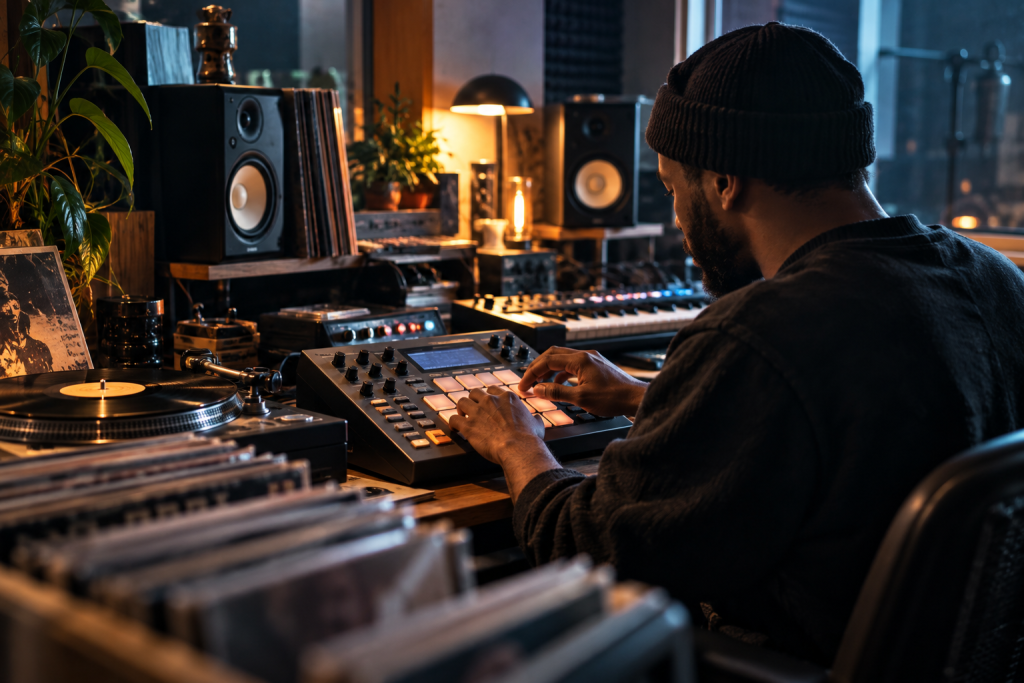
Every producer hits the same wall. You find a loop, drag it in, and it sits there doing its thing. Fine. But fine isn’t a track. The moment you slice it, reverse a tail, pitch it down three semitones and rebuild the rhythm, it stops being someone else’s demo and starts being yours.
Chopping and resampling is the line between using samples and making music out of them. Here’s how I actually do it, plus the part most tutorials skip: what you can legally get away with.
First, know what you’re sampling
When people say “sample,” they usually mean one of three things, and each one behaves differently in the DAW.
- Loop sampling is dropping a full musical phrase, two or four or eight bars, and building around it. Least work, least flexibility.
- Chop sampling is cutting and rearranging sections of that loop into a new rhythm or melody. This is where the flipping happens.
- One-shot sampling is grabbing a single sound: a kick, a snare crack, a vocal stab. Tiny pieces, huge creative room.
That’s the standard taxonomy, and it maps cleanly onto how a track gets built. A jazz loop is chop territory. A dusty drum break is one-shot territory. Knowing which one you’re working with decides your whole workflow before you touch anything.
The chop workflow that doesn’t kill the groove
The mistake I see constantly: chopping a loop into 16 equal slices, mapping them to pads, and playing them back in order. Congratulations, you made the original loop with extra steps.
Don’t slice on the grid. Slice on the transients. Most DAWs let you detect them automatically, but I usually nudge the markers by hand because the auto-detect never catches the ghost notes and half the character lives there. Once the slices are set, that’s your raw material, not your arrangement.
A few things that make chops actually sound like a new idea:
- Reorder, don’t replay. Rearrange the slices into a melody that was never in the source. If the loop went 1-2-3-4, try 1-4-2-3 and see what falls out.
- Leave gaps. Space between chops creates anticipation. Silence is an instrument.
- Detune selectively. Pitch one slice down a semitone to make it sit under the next one. Chops that all share the same pitch sound stacked; chops that move sound played.
- Reverse sparingly. A reversed slice as a transition or pickup is gold. A whole reversed loop is a cliche.
If you’re pulling from a royalty-free pack, this is not optional. Even pre-cleared libraries usually have other producers using the same loops, and a raw loop dropped in is a collision waiting to happen. Flip it, chop it, or layer it, and you create distance from everyone else who downloaded the same file.
Resampling is your sound design shortcut
Resampling means bouncing audio down and then working on the bounced file: print it, run it through effects, and print again. It’s not exotic. It’s just commitment.
Here’s why it matters. When you resample, you stop tweaking parameters and start treating the sound as raw material. The filter automation you printed is now permanent, which means you can chop it, stretch it, or drop it into a sampler and treat it as an instrument. You can’t do that with a live synth patch still tethered to its LFO.
A practical chain I use a lot: take a vocal phrase, resample it through a pitch shifter, print that, then chop the printed version into a new rhythm. You now have something that shares DNA with the original but doesn’t exist anywhere else. That’s the goal.
Same logic applies to drums. Resample a break, then chop the resampled break. You’re now processing your own performance, which is a completely different head space than managing a plugin’s parameters.
The legal part nobody wants to hear
If you’re chopping a loop from Splice, Loopmasters, Cymatics, LANDR Samples, or Output Arcade, you’re mostly fine. Those libraries are pre-cleared. Read the license anyway, because the terms aren’t uniform. Some allow royalty-free use outright. Others are free for small indie releases but trigger a license requirement once you cross a certain stream count or get a label placement. That threshold is where people get caught out.
If you’re pulling from an actual released song, it’s a different conversation. Every recording carries two separate rights: the sound recording (the audio file itself) and the composition (the melody, harmony, and lyrics). Different owners. You generally need clearance for both.
There’s a common myth that chopping enough makes it legal. It doesn’t. The more you transform a sample, the more creative protection you may have, and transformative use might help in a fair use defense. But it’s a gray area, and it doesn’t automatically make anything legal. I wouldn’t build a release strategy on it.
The clean routes are: license the sample properly (Tracklib sells samples with pre-priced licensing, and clearance services or publishers like Harry Fox Agency handle the rest), use pre-cleared packs, or interpolate. Interpolation means replaying the part yourself with your own instruments or vocals. You avoid the sound recording entirely and only need to clear the composition. It’s more work. It’s also how a lot of pop and rap reimagines old hits.
And don’t assume your track is too small to matter. Indie tracks go viral and get taken down or demonetized all the time because nobody cleared the sample.
Keep records even when you think you don’t need them
If you do go through clearance, save everything: emails, agreements, payment receipts, licenses, contracts. This matters when a track picks up traction or you sign a deal and suddenly need to prove you had the right to use something. Reconstructing that paperwork six months later is miserable.
Even for royalty-free packs, I keep a simple project note with the pack name and source. Costs nothing, saves a headache.
What to actually do next
Grab one loop. Not a full song, just a loop. Chop it on transients. Rearrange it into something that doesn’t resemble the original. Resample the result. Chop that.
That’s the whole technique. The gear is secondary, and no plugin is going to do the creative decisions for you. Chopping and resampling is about refusing to accept the sample as finished material, and treating it as clay instead. Do it once and the loop you skipped past last week becomes the one that carries the track.