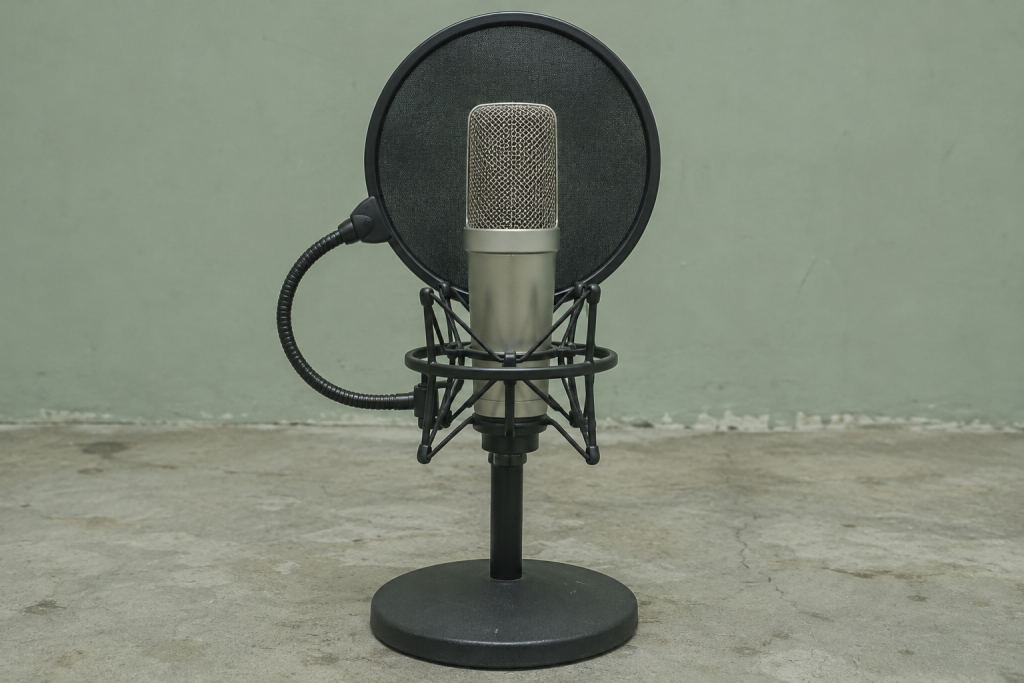
The mic you can drop in a bag without flinching is worth more than the one that lives in a case at home, and no field recording kit under $200 needs to be precious about it. We have three we actually carry outside: one dynamic that survives rain and gravel, one small-diaphragm condenser for detail, and one stereo-capable option that skirts the ceiling of the budget. None of them are fancy. All of them get used.
Before anyone starts pricing shock mounts and windscreens, a word on where the money should go. The mic is the single biggest factor in what your raw capture sounds like, full stop. A better mic into a modest interface beats a cheap mic into an expensive one, which is the same logic a mixing engineer would give you about vocals and the same logic we apply to field kits. Spend on the thing that touches the air. The interface is secondary.
What “field recording” actually demands from a mic
Studio mics and field mics are asked to do different jobs. Indoors you have a treated-ish room, a stable stand, no wind, and the option to re-take. Outside you get handling noise, gusts, traffic, humidity, and the occasional person who wants to know what you’re doing. A field mic needs to be tough, quiet enough at the self-noise level that you’re not recording hiss at low gains, and light enough that a boom or pistol grip doesn’t wear your arm out by the second hour.
There is also a character question. A condenser gives you clean and detailed, a dynamic gives you rugged and warm, and most people assume five condensers from five brands is variety. It isn’t. Build contrast instead: one bright, one dark, one detailed, one that just keeps working when the others would flinch. Our three picks are chosen for that contrast, not for spec-sheet parity.
Pick one: a dynamic that refuses to die
The Shure SM58 sits under $100 and doubles as a vocal mic, a percussion mic, and a hammer if you’re angry. Its frequency response rolls off the highs, which is a problem for dialogue and a gift for anything percussive or already-bright: a metal pipe, a fence, a hand slapping a tree. It rejects wind better than most condensers because the capsule is buried deep behind a grille. The trade-offs are real: less top-end detail, and the off-axis sound is boxy. If your goal is birdsong or ambient church interior, this is not the mic.
If you already own one for vocals, it is a free field mic the day you decide to go outside. That counts for a lot under $200.
Pick two: a small-diaphragm for detail
The Rode M5 is a matched pair of small-diaphragm condensers for around $150, which technically blows the budget if you buy it new, but the pair means you can record a stereo pair of dawn chorus or a single source with the second as backup. Failing that, a single Audio-Technica AT2021 or similar pencil condenser in the $70-$100 range gets you the brightness and transient snap that a dynamic smooths over. Leaves rustling, rain on a tarp, an acoustic instrument outdoors. The self-noise is low enough at 48V that quiet environments stay quiet.
The catch: small-diaphragm condensers punish handling noise and wind. You will need a foam windscreen and a decent shock mount, and that is where the budget creeps. Buy the windscreen before you record your first take, not after.
Pick three: a stereo option that fits
One underrated route is a stereo-capable dynamic or a small stereo condenser that records two channels into a single interface input pair. The Zoom H-series recorders include built-in stereo mics and cost less than a decent condenser, and our interface picks all use USB-C with enough gain to run them as a line feed. That is not a “mic” in the traditional sense, but it is the most practical way to capture a soundscape under $200 without buying three transducers.
If you insist on a single mic, a used Rode NT4 or similar stereo condenser occasionally shows up under the budget and saves you the matching headache. It is not weatherproof, so treat it like the sensitive instrument it is.
What to plug them into
Gain matters more than converter magic here. The Focusrite Scarlett Solo 4th Gen gives you up to 69dB of gain on one preamp, which is the difference between a dynamic mic being usable outdoors or being barely audible. The Scarlett 2i2 4th Gen in the same generation doubles the preamps and both instrument inputs sit on the front panel, so a hand-held dynamic and a condenser pair can record at once. Both sit at the bottom of the interface market and both work.
Check the gain before you leave the house. A dynamic that sounds fine in your room can be a whisper in a field if the preamp is the previous generation. The 69dB figure is the one to look for on a Scarlett.
How we actually test outside
One hour, one phrase, one location. Take five or six mics if you can borrow them and record the same 20-second sound on each: a footstep on gravel, a door closing, the nearest traffic. Set the input so the loudest peaks sit around -6dB and don’t touch the gain after that. Listen back on headphones outside and inside, and then run the recordings through the processing you’d actually use, because a raw take that sounds fine alone can fall apart once you compress and EQ it.
That test will tell you more about a field kit than any spec sheet. Some mics crumble under processing. Others just hold. The three above hold, and they hold at prices that don’t make you nervous when the strap slips.
A note on sample packs
If you’re recording to build your own sample library rather than a live gig, the same logic reapplies: one good capture beats ten mediocre ones layered together. We’ve said it before about sample packs, and it holds for field kits. A single clean recording of a gate hinge, made with a mic that respects transients, is worth more than a folder of low-quality textures that need rescuing in the DAW. Start with the mic, not the library.
Buy the SM58 first. It will outlive most of your other gear and it will still be the mic you grab when the weather is wrong.