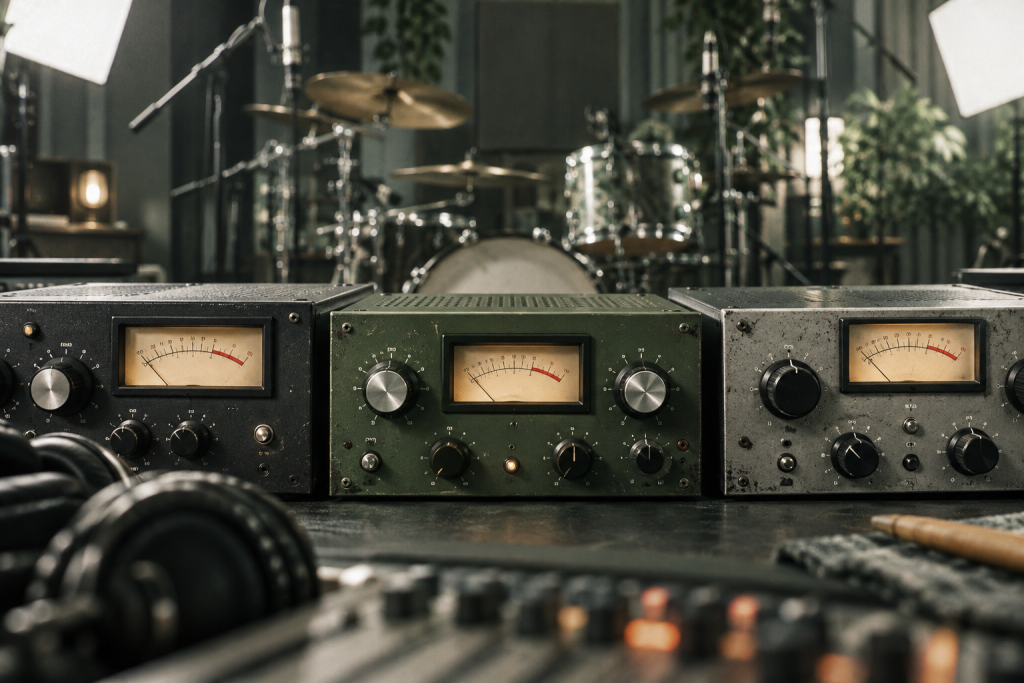
Three compressors, one drum bus, and a mix that either gels or falls apart: that is the whole test. We picked three budget options and ran the same bus loop through each one, and only one of them behaved like something we would keep on the mix template. The other two are usable, but with caveats you need to know before you spend anything.
A quick word on method. The loop was a straight four-to-the-floor house pattern, kick, snare, closed hats and a shaker, plus a bus of room mics. No vocals, no bass, nothing to mask the compression artifacts. If a plugin pumps or smears on that loop, it will smear worse once the full arrangement hits it. We dialed each compressor until the needle showed a light touch of movement, matched the output, and listened on monitors and headphones. The verdicts below are from that loop and from a couple of test sessions on other material, because a compressor that only works on one drum loop is not a compressor, it is an effect.
What “budget” actually means here
We are not counting the freeware tier as the same category as paid budget plugins. Some free compressors genuinely do the job, and a couple of commercial compressors recently went freeware, so the line is blurrier than it used to be. Fircomp 2, originally commercial and re-released as freeware, is described as incredibly clean and transparent and able to handle everything from subtle control to limiter duties, though the learning curve is steeper than average. That is a free plugin that earns its keep on a drum bus if you spend the time with it. But for this test we focused on paid budget options, because most people asking this question are choosing between three cheap purchases, not deciding whether to open their wallet at all.
The contenders and how they held up
1. An SSL-style bus compressor clone (the safe bet)
The SSL Bus Compressor’s appeal is punch and cohesion, and there are emulations of it from SSL, Waves, IK Multimedia, Slate Digital, Universal Audio, Cytomic and Native Instruments, among others. On drum buses specifically, the classic settings matter less than the behavior: slow attack, fast release, moderate ratio, small amounts of gain reduction. When we set one of these clones conservatively (attack around 30 ms, release fast, 2:1, 2 to 3 dB reduction) the loop tightened up without losing the transient snap on the kick. The low end got a little more solid, the hats stopped darting around, and the whole thing sounded like it came from the same session rather than a folder of samples.
What we did not like: the cheaper clones can add a slightly smeared top end when you push past 4 dB of reduction. It is not a dealbreaker, but it tells you these are bus compressors for gentle gluing, not for aggressive dynamics. If the drum bus needs to be squashed hard, this style is not the tool.
2. An FET-style (1176-type) compressor
The 1176 family, first sketched out by Bill Putnam Sr. toward the end of the 60s, is revered for its aggression and character, and the plug-in versions ship as different revisions that each behave like a different pedal on the same board. Revision A, the Bluestripe, is known for distortion characteristics and can aggressively enhance drum tracks, while Revision E is more transparent. On the drum bus, we preferred the more transparent revision, using about 3 dB of gain reduction with a medium attack. It brought the snare forward and made the kit feel more energetic, almost like it had been re-performed with more intent.
It also did something we did not want: it thickened the room mics in a way that crowded the kick. That can be fixed with a sidechain filter or by lowering the input into the detector, but if you are buying a budget FET emulation expecting plug-and-play, allow for those 20 minutes of tuning. When it works, it works well. When it does not, it sounds like a compressor that is showing off.
3. A clean, transparent compressor (the surprise)
Our third pick was a no-frills clean compressor, the kind that does not color anything. On a drum bus this sounds counterintuitive, because glue usually comes from a little character. But there is a real use case: if your drum bus is already processed with saturation or tape emulation, a transparent compressor will not pile on more coloration. It just controls the peaks and lets the existing character through.
This one was the most finicky to dial in. Attack and release had to be set carefully to avoid a slightly dull, lifeless result on the loop. Once we found the setting, though, it controlled the dynamics better than either of the colored options, with no pumping on the kick and no strange top end on the hats. It is not the plugin for a bus that needs glue. It is the plugin for a bus that needs control and nothing else.
Which one should you buy?
If we had to pick one for a drum bus, it would be the SSL-style clone, run gently. It glues without doing anything weird, and the settings are forgiving if your bus is a mess. The FET-style comes second, and only if you want attitude and are willing to shape the detector with a sidechain filter. The clean compressor is for people whose drum bus is already colored by other processors; it solves a specific problem, not a general one.
That said, there is a real argument for using two of them in sequence on a drum bus: a gentle SSL-style glue first, followed by a touch of FET for character on the snare bus only. We tested that chain on the loop and it was better than any single plug-in. The catch is you now own two budget compressors, and the sum of the two might get you close to a single mid-priced option. If you are strictly in budget territory and plan to buy one, buy the gluer.
Two closing notes from the test, because they change the answer more than any of the three plugins does. First, attack and release matter more than the brand. On every one of these, a slow attack preserved the kick and a fast release kept the bus from breathing between hits. Set those before you judge the character. Second, a sidechain filter, high-passing the detector around 100 to 150 Hz, cleaned up all three, especially the FET clone. If a budget compressor has an external sidechain input, use it. The drum bus is where that feature stops being a checkbox and starts being the difference between punchy and muddy.