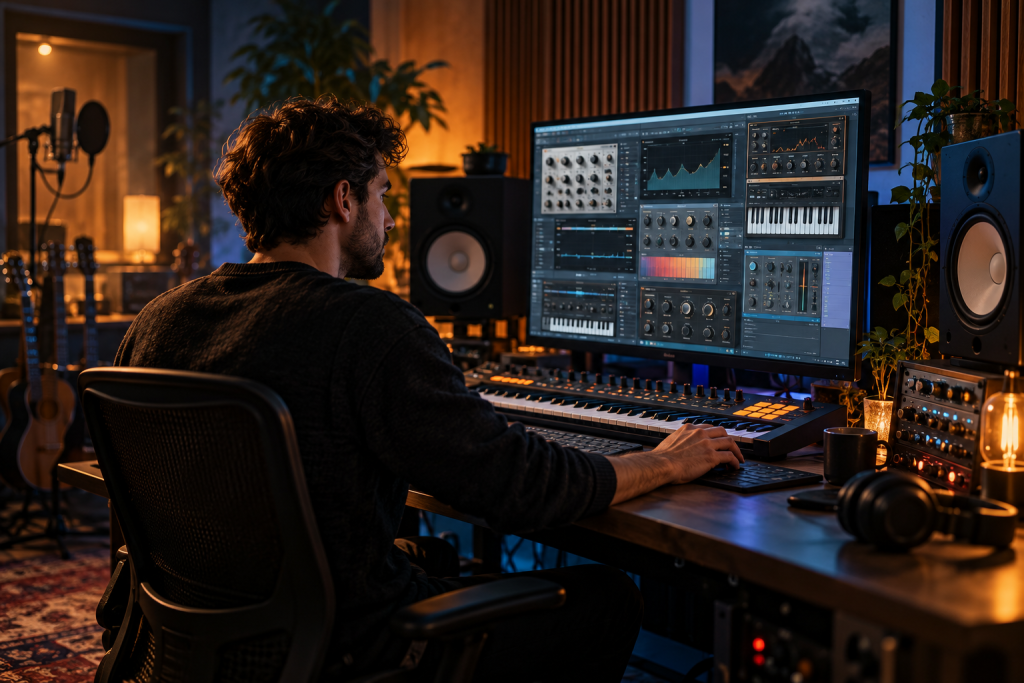
Most “best free VST” lists are a dumpster dive. Fifty plugins, no context, and you end up installing more than you make music with. I’ve wasted whole weekends on that. So this one is short on purpose: seven free tools that cover the actual jobs you do in a session, synthesis, EQ, dynamics, saturation, and space. Nothing here is filler.
The other rule I set for myself: only stuff that still gets updates. A free plugin that was abandoned three years ago is a liability once your DAW or OS moves on, and that’s the single most common trap in the freeware ecosystem. A decade ago “free” usually meant a compromise. In 2026 it mostly doesn’t. Major developers now ship stripped-back but fully professional versions of their paid tools, and independent developers on donation models are writing DSP that embarrasses plugins people paid for.
Here’s what actually earns hard drive space.
Synths: where free stopped meaning “toy”
Vital by Matt Tytel
If you install one thing from this list, install Vital. It’s a spectral warping wavetable synth, and its feature set genuinely matches Serum and Massive rather than imitating them from a distance. Drag-and-drop modulation, a visual interface that shows you what you’re doing to the waveform, and a free tier that includes full synthesis, not a locked demo. The paid tiers add preset packs, not engine features, so the free download is the whole instrument.
The ecosystem is the real reason it belongs at number one. There are dozens of free soundbanks and hundreds of tutorials on YouTube, which makes Vital the easiest free synth to actually learn on. I’d argue the UI is its best feature. Complex engine underneath, but you can dial a usable patch in five minutes without the manual.
Surge XT by Surge Synth Team
Surge XT is the opposite personality: open source, built for people who want to design from scratch, and happy to be complicated. It’s a subtractive hybrid synth with twelve oscillator algorithms covering FM, wavetables, S&H, and audio input, plus a deep modulation matrix and a huge pile of filter types. It ships with 2,285 presets if you’d rather not program, but that’s not why you install it. You install Surge XT when Vital’s engine isn’t weird enough for what you’re hearing in your head. It gets regular community updates, which matters more for open source than anything else on this list.
Dexed
Dexed is a faithful emulation of the Yamaha DX7, and it loads original DX7 SysEx patches. That last part is the whole point. FM synthesis has a reputation for being hostile, and a lot of that reputation comes from the original hardware’s interface, not FM itself. Dexed puts the same engine behind a modern UI, and the internet is full of free DX7 patches to pull apart. If you make anything that needs glassy keys, metallic basses, or those classic ’80s bells, this is the free answer.
Helm
Helm is the lightweight pick: two oscillators, a sub, built-in effects, a step sequencer, and a clean visual interface. It’s polyphonic and straightforward in a way the others aren’t. No deep menu spelunking. For simple pads, plucks, and basses where you don’t want to think, Helm is faster than opening a big synth. It won’t replace Vital or Surge XT, but it’s the one I reach for when the idea is small and I don’t want to get lost.
Effects: the tools that do the unglamorous work
TDR Nova
Nova is a dynamic EQ, and it’s the most useful free plugin that almost nobody talks about in the same breath as the synths. A dynamic EQ means each band can react to level, so you can carve a resonant frequency only when it actually pokes out, instead of notching it permanently. That’s how you fix a muddy sample without gutting it. You can run it as a straight EQ too. On a $0 budget, Nova handles your EQ and your multiband dynamics in one window.
Chow Tape Model
Tape saturation gets sold as a magic warmth button, which is mostly nonsense. What Chow Tape Model actually gives you is control over the specific behaviors of tape: saturation, wow and flutter, and the filtering that comes with the medium. That makes it useful for two very different jobs. Push it hard on a drum bus for grit and compression. Or use it gently on a sample to glue it to a beat it didn’t originally belong to. Free tape emulations are usually either one-knob toys or unstable messes. This one is neither.
Valhalla Supermassive
Supermassive is a reverb and delay with 18-plus modes, built by the same team behind Valhalla‘s paid reverbs. It’s permanently free, near-zero CPU, and the tails are enormous. This is not a subtle room reverb. It’s the plugin you use when you want a sound to bloom for eight seconds and swallow the mix. Modes range from huge halls to warping, pitch-shifting weirdness. For ambient work, pads, and transition effects, it’s the most fun free plugin you can download. Just don’t put it on everything, because it will eat your low end and your clarity along with it.
What I left off, and why
You’ll notice there’s no free compressor in this list, no limiter, and no utility plugin. That’s deliberate. Free compressors exist and some are decent, but dynamics is the one category where paid tools still pull clearly ahead, and your DAW’s stock compressor is usually the smarter choice over a weaker free third-party. I’d rather you use a stock plugin that works than install three that don’t.
I also cut the classics that look good on paper. There are hundreds of free VSTs online, and finding good ones takes time, which is exactly why a filtered list beats a long one. Loading your DAW with 200 mediocre instruments and effects slows your workflow and your computer, and mental bandwidth is the thing you actually run out of.
How to evaluate anything free before you trust it
Before a free plugin earns a permanent slot, I run it through the same checklist I’d use on a paid one. It takes five minutes and saves hours.
- Does it survive a real mix? A plugin that sounds great soloed on a demo patch often falls apart once drums and bass are in the picture. Test it in context, not in isolation.
- Is it stable? Crashes, random latency, and unpredictable behavior across DAWs are the classic freeware sins. If it glitches once, note it. If it does it twice, uninstall.
- Is the UI workable? If you need a manual to move a slider, you’ll stop opening it. Workflow beats features every time.
- Is the developer still active? Abandoned plugins become liabilities as DAWs and OS versions evolve. Check the last update date before you commit.
- Does it support VST3? That’s the modern standard. A VST2-only plugin in 2026 is a road you don’t need to walk down if a VST3 alternative exists.
One last thing about formats. Vital, Surge XT, and the rest here run as VST3 and AU, and most cover Windows and macOS. Check your DAW’s supported format before you download a pile of installers you can’t use.
Grab Vital first if you have nothing. Add Nova and Supermassive next, and you’ve covered your synth, your EQ, and your space for free. That’s a full production setup, and it cost nothing but the download time.