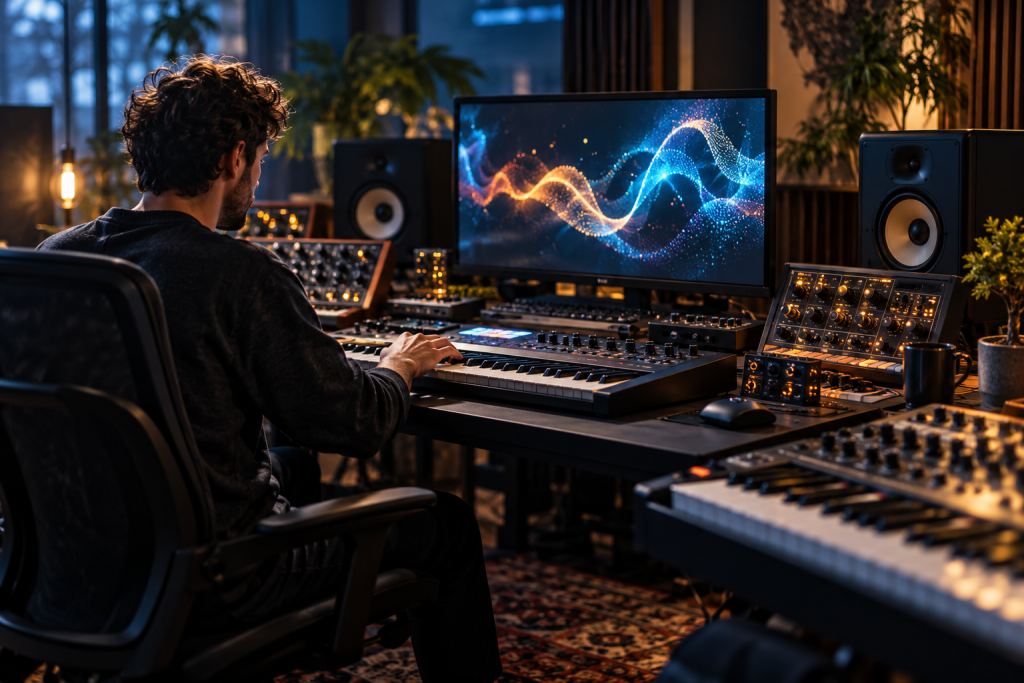
Most sound design plugin lists read like spec sheets. This one is built from the wreckage of actual sessions: tools that survived, tools that got uninstalled, and the two or three that keep ending up in every project. If you make sample packs or design texture for other people, you care less about “features” and more about whether a plugin gets you to a sound nobody has heard before. That filter changes the list a lot.
Sound design is not the same job as mixing. A compressor that flatters a vocal bus may be useless when you are trying to turn a field recording of a bus door into a synth pad. The tools below are the ones I reach for when the sound does not exist yet and I have to build it.
Synths that do things other synths can’t
Sonic Charge Synplant 2 is the one I would keep if someone took away everything else. Instead of drawing envelopes, you grow branches from 12 slots on the UI and the sound mutates as you drag. Everything you touch produces something you did not predict, which is exactly the point. Version 2 adds Genopatch: you feed it any audio and its AI tries to rebuild that sound from scratch, then spawns a cluster of variations around it. It runs $149 from Sonic Charge. The catch is that Synplant resists precise control. If you need to dial in an exact harmonic, this is the wrong tool. If you are hunting for a sound you can’t describe, there is nothing faster.
Vital is the free wavetable synth that forced a rethink about what freeware can be. Spectral warping plus a visual modulation system means you can watch a wavetable bend in real time while you modulate it. It is also the best value in synthesis, full stop, because it costs nothing. Pairs well with the wavetable workflow if you are already comfortable in that world.
For analog character rather than wavetable weirdness, Diva remains the reference point. It is a gold mine for warm, slightly imperfect subtractive tones, though it is heavy on CPU when you stack voices. Serum still holds its ground as the versatile workhorse: it sounds phenomenal and covers a huge range, but the wavetable engine has been copied enough that it no longer feels exotic. Omnisphere sits in a different category entirely, less a synth than a library of weird and wonderful samples with synthesis wrapped around it. If your sound design starts from sampled material rather than oscillators, that matters.
Morphing and hybrid tools: where new sounds actually come from
Zynaptiq Morph 3 is the plugin I would point a skeptical producer toward. It takes two input sounds and produces a genuine hybrid with elements of both, and you can sweep between the sources. This is not crossfading, not sidechain ducking, and not the same as what you get from Wavesfactory Trackspacer or Devious Machines Texture. Those tools layer or carve space. Morph builds a third sound that did not exist in either input.
The pedigree is real. Earlier versions have been used in games and film for years, including work on the DOOM soundtrack and Blade Runner 2049. Morph 3 Pro is the version I would look at for techno and heavier design work, and the whole family lands squarely in “sample pack machine” territory. You feed it a metal hit and a choir, and you get something you can pitch, resample, and chop into a kit.
The spatial angle
Sound Particles Skydust 3D belongs here because it treats space as a design parameter, not a mixing afterthought. Placing sounds in three dimensions changes how a texture reads, and for cinematic or game-adjacent work that is half the job. Transpanner 2 takes a more psychoacoustic route: it uses crosstalk cancellation to place sounds behind the listener. That is a specific trick, and when it works it is genuinely uncanny. It is not a general-purpose tool and you should not expect it to be.
Reverb and space: the tools that shape depth
Valhalla Supermassive is free and does one thing extremely well: massive, evolving ambient washes built on feedback delay networks. It is not a realistic room. It is a texture generator, and at that job it is close to unbeatable for the price.
Sonic Academy VELA takes a different approach. Its node-based graph system means you draw how reflections bloom and fade rather than loading “Hall A” and nudging a slider. The built-in ducking and de-essing keep it lush without turning into mud, which I have found especially useful on vocals. If you want to design your own acoustic fingerprint instead of borrowing someone else’s, VELA rewards the time you put in.
For precision rather than character, FabFilter Pro-R 2 and iZotope Aurora sit at the controlled end of the spectrum. And for experimental depth, Lese Hikari goes places that clean algorithmic reverbs will not. The honest trade-off here: the more distinctive a reverb sounds, the harder it is to place in a busy mix. Character reverbs are design tools, not utility tools.
Free utilities that punch above their weight
Not everything has to be exotic. TDR Nova is a dynamic EQ that handles frequency-dependent compression with real precision, and it is free. Xfer OTT is the multiband upward compressor that defines the hyper-real electronic sound; you either love what it does to a synth bus or you avoid it. Softube Saturation Knob does one thing: modeled output distortion with a frequency focus, good for aggressive grit and warming a drum bus. TAL-Chorus-LX is an authentic Juno-60 BBD emulation, which means lush vintage stereo widening for nothing. Spitfire LABS gives you high-fidelity, human-performed organic textures if your design leans toward the emotive end.
One rule before you install any of these: check that the developer is still shipping updates. Abandoned plugins become liabilities as your DAW and OS move on. VST3 is the modern standard, AU matters on macOS, and AAX only if you live in Pro Tools. Stability and workflow matter more than the feature list, because a plugin that crashes mid-session costs you a sound you will never recreate.
How I’d actually sequence these
Start with a source. Field recording, synth patch, sample, whatever. Then ask what transformation you want.
- Want a hybrid of two unrelated sounds? Morph 3.
- Want to reverse-engineer a reference into something new? Synplant 2 with Genopatch.
- Want to build a texture from scratch with full control? Vital or Serum.
- Want to make it feel three-dimensional? Skydust 3D or Transpanner 2.
- Want to stretch it into ambient space? Supermassive or VELA.
- Want to glue or grit the result? OTT and Saturation Knob.
The temptation with sound design plugins is to collect them. I have hundreds installed and I still open the same five on most days. The real skill is knowing which transformation the sound needs, then reaching for the one tool that does it without a fight. Buy Synplant and Morph if you can afford the spend. Everything else on this list you can cover with free options that hold up in a real session. That is the thing worth knowing about 2026: the free tier is no longer a compromise, it is a legitimate starting rig.